Scientists say such blazes produce greenhouse gases
BY TIM JOHNSON • MCCLATCHY NEWSPAPERS • November 16, 2008
RUJIGOU, China — The barren hillsides give a hint of the inferno underfoot. White smoke billows from cracks in the earth, venting a sulfurous, rotten smell into the air. The rocky ground is hot to the touch, and heat penetrates the soles of shoes.
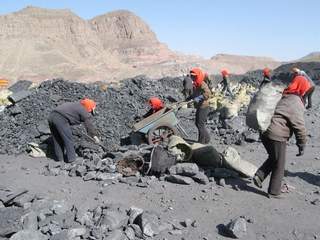
Beneath some rocks, an eerie red glow betrays an unseen hell: the epicenter of a severe underground coal fire.
“Don’t stay too long,” warned Ma Ping, a retired coal miner. “The gases are poisonous.”
Another miner tugs on the sleeve of a visitor.
“You can cook a potato here,” said Zhou Ningsheng, his face still black from a just-finished shift, as he pointed to a vent in the earth. “You can see with your own eyes.”
China has the worst underground coal fires of any country. The fires destroy as much as 20 million tons of coal annually, nearly the equivalent of Germany’s entire annual production. The costs go beyond the waste of a valuable fuel, however.
Scientists blame uncontrolled coal fires as a significant source of greenhouse gases, which lead to global warming. Unnoticed by most people, the coal fires can burn for years — even decades and longer — seeping carbon dioxide, methane and other gases that warm the atmosphere.
“Coal fires are a disaster for all of humanity. And it’s only due to global warming that people are finally beginning to pay attention,” said Guan Haiyan, a coal fire expert at Shenhua Remote Sensing and Geo-engineering Co.
The rising demand for coal worldwide to satisfy a hunger for energy has given way to greater mining and a proliferation of fires in coal seams and abandoned mines. China, which has tripled coal production in the past three decades, has mobilized thousands of firefighters to combat the 62 known coal fires that are scattered across its north.
Major fires have been extinguished. However, Dutch scientists scribbling back-of-the-envelope calculations say that coal fires in China may still be the cause of 2% to 3% of the world’s annual emissions of carbon dioxide from burning fossil fuels.
The scientists call for greatly increased efforts to extinguish China’s coal fires — and those in places such as India, Russia and Indonesia — as a practical step to fighting global warming.
“It’s a relatively cheap way to stop greenhouse gas emissions,” said Horst Rueter, a German geophysicist who is the scientific coordinator for a Sino-German initiative to combat China’s coal fires.
Rueter said he thought China’s coal fires accounted for at least half the global emissions from coal fires around the world, making them a steady source of pollutants.
Others say that such runaway fires, while significant, pale beside overall emissions from the United States, a fossil fuel glutton that may give off 25% of the world’s greenhouse gases.
How fires happen
Coal fires can occur naturally and are not a new phenomenon.
• Australia’s Burning Mountain has smoldered for thousands of years.
• An underground coal fire in Centralia, Pa., began in 1962, eventually opening sinkholes that threatened to gobble and incinerate pets and children. Centralia became a ghost town, and experts say the fire there may burn for a century or more.
• At the Rujigou coalfield in the Ningxia Autonomous Region of western China, fires have burned since the late Qing Dynasty (1644-1911).
Many coal fires begin spontaneously when underground seams come in contact with the air — either through fault lines from earthquakes or mining activity — generating a chemical reaction that can slowly heat and ignite the coal. Human activity is an intensifier of the fires, however, especially when workers abandon dust-filled mines without sealing the airshafts, allowing temperatures to build.
China’s coal fires stretch across a northern belt that runs nearly 3,000 miles from east to west. A cluster of them are in Ningxia and a little to the north in Inner Mongolia at the edge of the Gobi Desert. The concentration of coal fires in the region puts it in the running for one of the world’s worst ecological disasters, and only humans can extinguish the problem.
“These fires just don’t go out,” said Anupma Prakash of the University of Alaska at Fairbanks, an expert on mapping coal fires.
The costs of coal
Coal fires pollute the air with putrid smoke and wreak havoc on water supplies and aboveground ecology, creating so-called heat islands where little vegetation can grow, not even hardy grasses. Wildlife flees.
Coal fuels China’s roaring economy, powering its factories but also taking a human, social and environmental toll.
China uses coal for 70% of its primary energy needs, far higher than the world average of 40%. China’s coal production topped 2.3 billion tons last year, equaling the output of the United States, Russia, Australia and India combined, said Yang Fuqiang of the Beijing office of the Energy Foundation, a San Francisco group that promotes energy efficiency.
Even as it provides power, coal exploitation leaves a trail of deaths.
Last year, 3,786 Chinese miners died in accidents, a rate 70 times higher than for miners in the United States.
Coal burning is a principal cause of air pollution in China, where 400,000 people die each year of illnesses related to that pollution, the World Bank estimates, mainly heart and lung diseases.
During the past decade, China has put far greater emphasis on attacking coal fires. The work is labor intensive, costly and dangerous in its initial stages. The blazes can reach underground temperatures of 1,300 to 1,500 degrees Fahrenheit, imperiling firefighters.